Knowledge, attitudes, and practices regarding human papillomavirus infections among women surveyed in Latin American countries
DOI:
https://doi.org/10.68178/j5vwge19Keywords:
Cervical neoplasms, Papanicolaou test, Human papillomavirus, Papillomavirus vaccines, Knowledge, attitudes, and health practicesAbstract
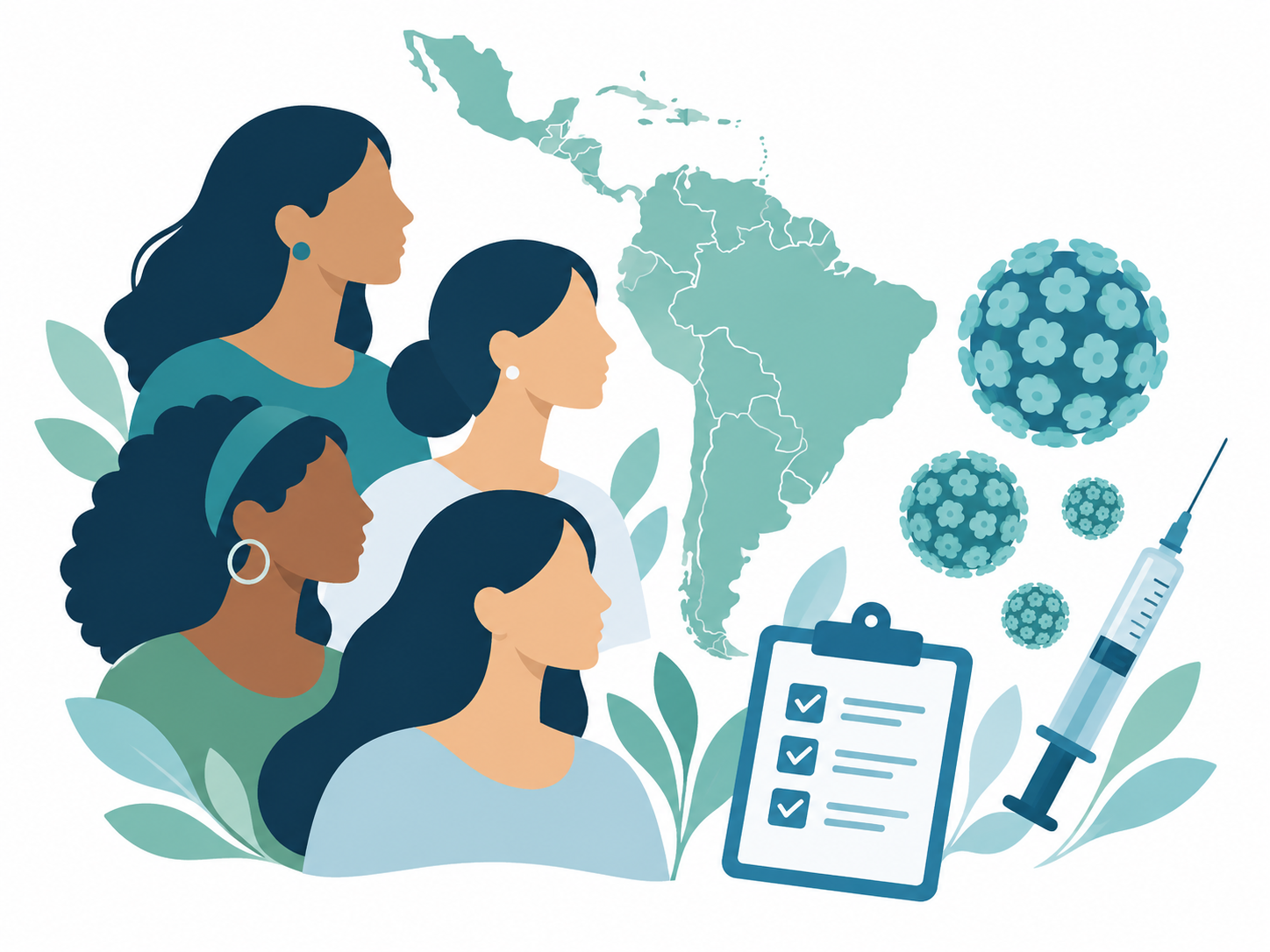
Objective: To assess women's knowledge, attitudes, and practices regarding HPV. Methods: An observational, descriptive, cross-sectional design was used. The study population consisted of women from Latin American countries during 2024 and 2025. The sampling was non-probabilistic, using a snowball method. Data were collected using an online survey, which included sociodemographic data, as well as knowledge, attitudes, and practices regarding the prevention and early detection of HPV infection. Results: The sample included 222 women, with a mean age of 23 ± 7 years. Most reside in Peru (35.59%) and Paraguay (26.13%). The main findings were: 86.94% recognize that HPV is a virus, 99.95% that it is sexually transmitted, 80.63% that it causes cervical cancer, 66.22% had heard of the Pap test, 34.68% had undergone the test, 81.53% knew about the HPV vaccine, and 86.49% knew that this cancer is preventable. Conclusions: The level of knowledge, attitudes, and practices regarding HPV among these women is acceptable, although their education should be improved to achieve higher vaccination coverage and to promote access to cervical cancer screening tests.
Downloads
References
1. Alfaro Castro A, Fournier Pérez M. Virus del papiloma humano. Rev Medica Costa Rica y Centroamérica [Internet]. 2013;LXX(606):211–7. Disponible en: https://www.medigraphic.com/pdfs/revmedcoscen/rmc-2013/rmc132d.pdf
2. Araya Yampey S, López Benitez J, Cousirat Sanabria L, Britos Martínez R, Castro Leguizamón H, Battaglia Paredes S, et al. Vacunación contra el Virus de Papiloma Humano en Paraguay, monitoreo de coberturas y datos de seguridad. Pediatría (Asunción) [Internet]. 2024;51(2):72–80. doi: 10.31698/ped.51022024002 DOI: https://doi.org/10.31698/ped.51022024002
3. Rossi PG, Baldacchini F, Ronco G. The possible effects on socio-economic inequalities of introducing HPV testing as primary test in cervical cancer screening programs. Front Oncol [Internet]. 2014;4(20):1–11. doi: 10.3389/fonc.2014.00020 DOI: https://doi.org/10.3389/fonc.2014.00020
4. de Sousa Gomes ML, dos Santos Moura N, de Carvalho Magalhães L, da Silva RR, Silva BGS, Rodrigues IR, et al. Systematic literature review of primary and secondary cervical cancer prevention programs in South America. Rev Panam Salud Publica [Internet]. 2023;47:e96. doi: 10.26633/RPSP.2023.96 DOI: https://doi.org/10.26633/RPSP.2023.96
5. Andersen A, Lefebre A, Pereira M, Vega R, Fernández C, Chávez P, et al. Guías prácticas para el manejo del cáncer de cuello uterino invasor [Internet]. 2022. 90 p. Disponible en: https://incan.mspbs.gov.py/guias-cervix/02_guia_cervix_090324.pdf
6. Galdós Kajatt O, Pacheco-Romero J. Avances en la prevención y manejo del cáncer cervical. Rev Peru Ginecol Obs [Internet]. 2023;70(4):1–2. doi: 10.31403/rpgo.v70i2701 DOI: https://doi.org/10.31403/rpgo.v70i2701
7. Luu XQ, Jun JK, Suh M, Oh JK, Yu SY, Choi KS. Cervical cancer screening, HPV vaccination, and cervical cancer elimination. JAMA Netw open [Internet]. 2025;8(8):e2526683. doi: 10.1001/jamanetworkopen.2025.26683 DOI: https://doi.org/10.1001/jamanetworkopen.2025.26683
8. Santacruz Váquez L, Kovacs Lohse V, Vega O A, Ocampos S, Mereles Aranda E. Lesiones preneoplásicas del cáncer de cuello uterino en muestras del Laboratorio de Anatomía Patológica del Centro de Investigaciones Médicas, 2013-2019. Rev Salud Publica Parag [Internet]. 2023;13(2):18–21. doi: 10.18004/rspp.2023.agost.04 DOI: https://doi.org/10.18004/rspp.2023.agost.04
9. Küçükyurt AK, Atakul N, Kolcu SA, Özcan AJ, Abdullazade N. Is age a determinant in cervical cancer screening in women aged 18 to 29?: An observational study. Med [Internet]. 2025;104(24):e42765. doi: 10.1097/MD.0000000000042765 DOI: https://doi.org/10.1097/MD.0000000000042765
10. Peirson L, Fitzpatrick-Lewis D, Ciliska D, Warren R. Screening for cervical cancer: A systematic review and meta-analysis. Syst Rev [Internet]. 2013;2(1):35. Disponible en: http://www.systematicreviewsjournal.com/content/2/1/35 DOI: https://doi.org/10.1186/2046-4053-2-35
11. Koliopoulos G, Nyaga V, Santesso N, Bryant A, Martin-Hirsch P, Mustafa R, et al. Cytology versus HPV testing for cervical cancer screening in the general population. Cochrane Database Syst Rev [Internet]. 2017;8(8):CD008587. doi: 10.1002/14651858.CD008587.pub2. DOI: https://doi.org/10.1002/14651858.CD008587.pub2
12. Mishra E, Chaudhary E, Mishra S, Rawat V, Tripathi S, Rathoria R, et al. Cervical cancer screening using Papanicolaou smear and visual inspection with acetic acid and their correlation with colposcopy. Cureus [Internet]. 2025;17(7):e88679. doi: 10.7759/cureus.88679 DOI: https://doi.org/10.7759/cureus.88679
13. Staley H, Shiraz A, Shreeve N, Bryant A, Martin-Hirsch PPL, Gajjar K. Interventions targeted at women to encourage the uptake of cervical screening. Cochrane Database Syst Rev [Internet]. 2021;9(9):CD002834. doi: 10.1002/14651858.CD002834.pub3 DOI: https://doi.org/10.1002/14651858.CD002834.pub3
14. Cerqueira R, Santos H, Prado N, Bittencourt R, Biscarde D, Santos A. Controle do câncer do colo do útero na atenção primária à saúde em países sul-americanos: revisão sistemática. Rev Panam Salud Publica [Internet]. 2022;46:e107. doi: 10.26633/RPSP.2022.107 DOI: https://doi.org/10.26633/RPSP.2022.107
15. Medina Fernández IA, Gallegos-Torres RM, Cervera-Baas ME, Cob-Tejeda RA, Jiménez-Laces J, Ibarra-Escobedo O. Conocimiento del virus del papiloma humano y su vacuna por parte de mujeres de una zona rural de Querétaro, México. Enferm Actual Costa Rica [Internet]. 2017;18(32):26–39. doi: 10.15517/revenf.v0i32.23575 DOI: https://doi.org/10.15517/revenf.v0i32.23575
16. Benítez González AC, Cañete Cañete NA, Vargas López SP, López Esquivel NY, Romero Gaona NMI, Riveros Adorno MA, et al. Nivel de conocimiento sobre VPH en estudiantes de la Universidad del Pacífico. Rev Cient Cienc Salud [Internet]. 2024;6:e6163. doi: 10.53732/rccsalud/2024.e6136 DOI: https://doi.org/10.53732/rccsalud/2024.e6136
17. Paez B M, Rodriguez Riveros MI, Kasamatsu E, Castro A, Orue E, Lampert N, et al. Conocimientos, actitudes y prácticas sobre virus de papiloma humano (VPH) y cáncer de cuello uterino en mujeres de 30 y más años de edad, de un barrio ribereño de Asunción, (Bañado Sur). 2012. Rev Univ Ind Santander Salud [Internet]. 2016;48(1):37–44. doi: 10.18273/revsal.v48n1-2016004 DOI: https://doi.org/10.18273/revsal.v48n1-2016004
18. Adrianzén Peralta AL, Villalobos Popuche VA, Lloclla Gonzales H. Correlación entre el nivel de conocimiento y la actitud frente a la vacuna contra el virus del papiloma humano en estudiantes de secundaria. Horiz Médico [Internet]. 2022;22(4):e1983. doi: 10.24265/horizmed.2022.v22n4.08 DOI: https://doi.org/10.24265/horizmed.2022.v22n4.08
19. Ndubuisi CC, Maphasha O, Okeke SO. Knowledge and awareness of cervical cancer and human papillomavirus vaccination among female university students. S Afr Fam Pr [Internet]. 2024;66(1):a5885. doi: 10.4102/safp.v66i1.5885 DOI: https://doi.org/10.4102/SAFP.v66i1.5885
20. Li M, Zhang F, Shi Y, Shi K, Li X, Bai H. Awareness of HPV and HPV vaccine among college students in China. Front Public Heal [Internet]. 2024;12(September):1451320. doi: 10.3389/fpubh.2024.1451320 DOI: https://doi.org/10.3389/fpubh.2024.1451320
21. Donkor A, Osei LP, Acquaah-Arhin EAK, Suka PD, Kitson-Mills D, Adjei ANA, et al. Determinants of cervical cancer knowledge and barriers to human papillomavirus vaccine uptake among female university students: A cross-sectional study. Women’s Heal [Internet]. 2025;21:17455057251335446. doi: 10.1177/17455057251335446 DOI: https://doi.org/10.1177/17455057251335446
22. Hernández-Sarmiento JM, Jaramillo-Jaramillo LI, Villegas-Alzate JD, Álvarez-Hernández LF, Roldan-Tabares MD, Ruiz-Mejía C, et al. La educación en salud como una importante estrategia de promoción y prevención. Arch Med [Internet]. 2020;20(2):490–504. doi: 10.30554/archmed.20.2.3487.2020 DOI: https://doi.org/10.30554/archmed.20.2.3487.2020
23. Elsaid NMA, Ismail HAH, Salim AA, Kamal D, Edris F, Ibrahim A, et al. The effect of educational intervention program on knowledge and take cervical cancer screening and human papillomavirus vaccine: A quasi‑experimental study. J Fam Community Med [Internet]. 2025;32:207–16. doi: 10.4103/jfcm.jfcm_45_25 DOI: https://doi.org/10.4103/jfcm.jfcm_45_25
24. Colón-López V, Ayala-Marín AM, Vélez-Alamo C, Soto-Salgado M, Medina-Cortés L, Acevedo-Fontanez AI, et al. ¡Habla de VPH! An educational activity for college students in Puerto Rico. P R Heal Sci J [Internet]. 2021;40(3):142–6. Disponible en: https://prhsj.rcm.upr.edu/index.php/prhsj/article/view/1773
25. Jaca A, Mathebula L, Malinga T, Rampersadh K, Zulu M, Hohlfeld AS-J, et al. Interventions to improve vaccination uptake among dults: A systematic review and meta-analysis. Vaccines [Internet]. 2025;13(8):811. doi: 10.3390/vaccines13080811 DOI: https://doi.org/10.3390/vaccines13080811
26. Chipana Díaz J, Del Aguila Chirito B, Panduro Reyes G, Vela-Ruiz JM. Cobertura del tamizaje de cáncer de cérvix en Latinoamérica. Rev Obs Ginecol Venez [Internet]. 2025;85(3):429–39. doi: 10.51288/00850313 DOI: https://doi.org/10.51288/00850313
27. Tokumoto Valera FS, Vidarte Paiva JC, Talavera JE, Ramirez-Ortega AP, Torres Malca JR, Vera Ponce V, et al. Factores que favorecen el tamizaje de cáncer de cuello uterino en mujeres de 12 a 49 años: Sub-análisis de la Encuesta Demográfica y de Salud Familiar 2019, Perú. Med Clín Soc [Internet]. 2023;7(1):17–25. doi: 10.52379/mcs.v7i1.268 DOI: https://doi.org/10.52379/mcs.v7i1.268
Downloads
Published
Issue
Section
License
Copyright (c) 2026 Raul Emilio Real Delor, Jorge Gabriel Mendoza Melgar, Víctor Hugo Inchausty Beltrán, Alberto Guevara Tirado, Maricel Pintos, Addriely Daihenne da Silva Faria, Eloísa Karolina Pereira Gomes de Araujo, Jamily Deisi de Souza Oliveira, Sara Sofia Cáceres (Autor/a)

This work is licensed under a Creative Commons Attribution 4.0 International License.
Los artículos publicados en Perspectivas en Ciencias Médicas y Biológicas se distribuyen bajo los términos de la licencia Creative Commons Atribución 4.0 Internacional (CC BY 4.0). Esta licencia permite compartir y adaptar el contenido para cualquier propósito, siempre que se otorgue el crédito correspondiente a los autores y a la publicación original, se proporcione un enlace a la licencia y se indique si se realizaron cambios. Los autores conservan los derechos de autor de sus trabajos.